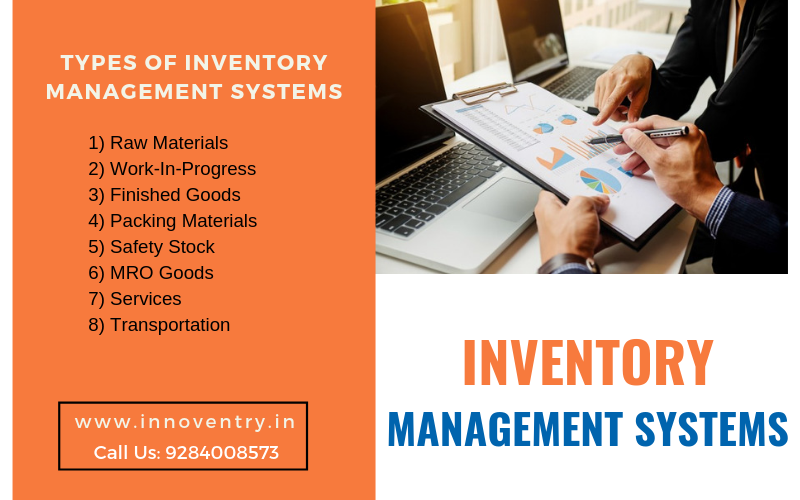
Types of Inventory Management Systems

Accounting software, Billing Software, Business Accounting Software, Inventory Management, Inventory Management Software, Inventory Management Systems,

Are you thinking of organising your business and adding a pro aspect of electronic or online management into it? Do you find it difficult to manually manage the inflow and outflow of resources and physical components of the business into that old ragged diary of yours? Is your business suffering from problems such as dead stock, high taxes, storage costs, and spoilage and space problems? All what you need is a good “Inventory Management system”.

Inventory management software for a successful business is needed for at different levels and at almost all the branches of the business. Taking the example of a restaurant, inventory is required at different stages, starting from the purchase of raw material i.e. the cooking ingredients followed by the inventory of raw material used for various dishes to determine the usage of the raw material. Then we will require an inventory of the dishes made each day to determine the selling streak of each dish. Furthermore if the restaurant has venture into online delivery then the inventory of package material used and required is also to be made.

Therefore inventory management is most efficient way to organize and regulate business in modern era of immense competition. In the above example of a restaurant we could see how inventory management can help to determine the capital invested on a particular product or range of products and then to determine what profit we made with the products sold. Same can be the case with any other business relating to shoes, books, steel, clothes or any other commodity. INNOVENTRY adds up these features of inventory management and billing procedures to give your business the tools for deciding amazing business ideas and adding clients to your business with no discrepancy such as billing errors from your side.

We at INNOVENTRY provide you with solutions to your varied problems from billing issues to inventory management and updating. But before venturing into this amazing gift of technology to modern day business let us first understand the types of inventory management systems which can really make your business stand out from other contemporary businesses following almost the same business model or any other business as a matter of fact.

1) Raw Materials
Every business starts with raw materials; they are the base of any business. They consist of the materials your business uses to produce its own goods.

Inventory of raw materials is important as firstly, it gives you the description and idea about the raw materials present to forecast your production of finished products and secondly, you can manage and determine the capital invested.

2) Work-In-Progress
Inventory of work in progress materials consists of the items from your raw materials that are put into the process of manufacturing them into the final furnished products. WIP inventory consists of

  • Necessary materials
  • Parts (components)
  • Assemblies
  • Subassemblies

3) Finished Goods
Then after production is complete you would require an inventory of the products post production and ready to be marketed sold to your valued customers. For example if your factory produces waffles, the packets of finished waffles is considered as the finished good.

4) Packing Materials
Most businesses need to pack a ship their finished products as seen in the above example that the restaurant for deliveries needs packing material.

Although packing materials might not seem like a significant expense. But your business does use a large amount of these supplies every day. If you don’t keep tight control of this inventory, the cost will quickly add up.

5) Safety Stock
Safety stock is the amount of product you keep on hand that exceeds what your business needs to satisfy regular demand. With good monitoring, tracking, and control, you can allocate certain types of inventory to protect against supply-and-demand uncertainties, low delivery reliability, and poor-quality components. This type of inventory cushion is called safety stock (or buffer inventory).

6) MRO Goods
MRO stands for Maintenance, repair, and operating supplies goods—these are items put in place to maintain tasks in the production process. These contribute to be one of the major components in the production process although they are not directly a part of the finished product.

MRO goods depend upon the type of business you do. For examples MRO goods for factories include gloves, safety gear, machine spares etc. and for shops include packing materials, binding material etc. Even office supplies like staples, pens and pencils, copier paper, and toner—all of the little parts that keep the wheels turning—are considered MRO goods inventory.

7) Services
Crucial to business success, service inventory includes the monitoring and management of all other types of inventory in the production process.

The principle product of many businesses is not always materialistic but there are businesses where the principle product they offer are the services they offer. For example some businesses give services like housekeeping, marketing, recruitment etc. They too need to keep account of the services they provide. Also businesses like insurance companies and automobile or appliance servicing companies need to be on their toes with their schedules and services they have provide, service inventory helps in them.

Your business will be able to rest assured knowing the production process is on a continuum and that your employees will always be on hand when needed. Now that’s what you call service inventory!

8) Transportation
If your business is about the transport sector then this kind of inventory is for you. If your business involves transporting of goods and materials from one location to other, this kind of inventory is a must for you. Merchandise shipped by truck or rail can sometimes take days (or even weeks) to go from a regional warehouse to your retail facility.

Inventory in transit must be accounted for when it comes to supply and demand, along with the timelines for those demands to be met.
If you are into any business then you need an effective inventory management system and INNOVENTORY can help innovate your inventory maintenance procedure in the most optimum manner.

Features of Inventory Management Software

Billing Software, Business Accounting Software, Features of Billing Software, Features of Inventory Management Software, Inventory Management Software, inventory management system,

Running a business, a factory or an industry? What bothers you the most? Sales and Profit. But it is impossible to obtain the level of sales that you aim for until you concentrate on managing your own product, the raw materials and the processing material such as spare parts of those machines which are required to create those awesome products of yours. “A place for everything and everything in its place,” goes the saying. Let’s add to that a label for everything and the means to track it all. And, how about some alerts when there’s too much of one item and a shortage of another? This mix pretty much sums up what inventory management software can do for your business.

Whether you are running a shoe store, grocery store, a multipurpose mart, e-commerce site, a logistics company or any business you name it, an inventory management system is must have if you want an easy going business where you can only concentrate on customer addition and sales improvement to enhance your ultimate goal that is profit. It will give you insights into every aspect of your products, and in some cases, will help you better understand your customers too.

What is an inventory management system? An inventory management system is a basically a tool that allows you to track goods across your business’s supply chain. It largely optimizes the entire process from order placement with your vendor to order delivery to your customer, mapping the complete journey of a product.

Moreover with features of inventory management software provides a business can come out to be miraculously profitable, it provides transparency to cash flow and the input as well as the output which in-turn has a big impact on the bottom line of a business. Inventory management softwares enable accurate tracking of goods; businesses can minimize waste, analyze trends, and make better investment decisions.

There are a range of features that an inventory management software provides which help you manage your worthy business. To choose an inventory management software following are some features to look up to,

1) BILLING AND INVOICE MANAGEMENT
In this era of fast paced business an inventory management software will provide you with super easy billing procedures. Added features such as customization and professional printing as well as sharing using e-mails as well as other means features should be present in the software. Also added logos of the business, signatures and proper placement of advertisements on the bill will even make the business impactful. Great inventory management softwares create great user oriented billing softwares which can make your business look very professional. This creates a professional image in the mind of the clients and leads to added buyers or clients. Duplicate invoices can also be created on the format of previous invoices.

2) BARCODE SCANING AND CREATION
Inventory management softwares have a feature which enables them to create barcodes for your unique products which can be used directly on to the billing and invoice creations for faster billings. Also barcodes can be used for online verification and authentication of your product. Unique Bar Code for the product specifying its quantity and rate can be created. Bar codes can also be generated at once for all the items in the purchase form by providing requisite information of the products. This reduces the billing time for the commodities and considerably increases the efficiency of sales in turn increasing profitability and revenue.

3) QUOTATION MANAGEMENT
Every business requires purchasing; it is basically the backbone of any business as raw materials and processing materials are required to create a furnished product. Inventory management softwares provide your business with professional quotations which can be generated in a blink of the eye with just one click. With it you can request quotations from vendors and generate purchase order which can help a business to manage and keep a digital check of its expenditure.

4) MARKETING AND NOTIFICATION FEATURES
Marketing is one of the most important components of successful business. Inventory management softwares provide users marketing facilities such as SMS notifications and payment reminders to its customers including promotional messages which can provide full fledged exposure and dedicated customer targeting. Businesses can send automatic SMS invoices notifications to their customers which can save both time and money.

5) STOCK NOTIFICATIONS
Receive alerts and notifications when there’s over- or under-stocking beyond a defined threshold. This helps you to place orders or offer promotional discounts to clear out extra stock.

6) ORDER MANAGEMENT
Most vendors offer an inventory management system that can help you manage your sales orders. These tools allow users to customize pricing, send quotes, track orders and manage returns. Some advanced systems sync orders with inventory levels, mark items for shipment, support multichannel sales and make auto-adjustments to maintain profitability. Order management is an essential feature to increasing and maintaining customer satisfaction using order tracking, sales order, quotations, order editing.

7) REPORTS AND ANALYTICS
Analytics informs you of when demand may be higher than expected, like during certain holidays. Use this data to prevent stock outages, which could result in a missed opportunity to grow your business. Reporting provides this data in ways that are easy to understand and share. These might include specialized PDFs or inbuilt dashboards. You might have the best insights in the company, but without an effective way to share them, they won’t be much use to you. Many tools allow users to also drill down a report to find the level of information necessary for their function.

8) MOBILE SUPPORT
This aspect affects what hardware you’ll be managing your processes on and if you’ll be able to do it remotely. Many systems offer a mobile website, which enables users to access the system from any desktop. If you utilize tablets, phones or other mobile devices, check to see if a vendor offers a native application. Mobile support is often OS specific, so it’s important to keep that in mind as well. While most vendors try to support all popular platforms, it’s not a universal concern. So it’s always important that the inventory app you invest in can run on your existing hardware.

9) MATERIAL GROUPING
Group inventory into predefined categories and ensure you’re always updated about quantities of components and specifications that make up your product stock, and manage their reordering schedules as required.

10) INVENTORY OPTIMIZATION
Maintain just the right amount of inventory for each product, without over- or under-stocking any item. It’s especially useful if you deal in products that experience a seasonal rise and fall in demand.

Design a site like this with WordPress.com
Get started